Thursday, March 1, 2018

Brisbane City Sketchers in South Brisbane

What a wonderful morning we had.  Three of us came out to sketch the historical South Brisbane Train Station.  It was a challenge for me as the humidity is really very high today, and i don't cope well on these days.. it is sitting on 70%

South Brisbane Station
The first station was constructed in 1884 on the corner of Melbourne and Grey Streets and opened as Melbourne Street railway station.
The second and current building was constructed on higher ground in 1891 as the terminus for the new rail extension from Boggo Junction (now Dutton Park railway station)
South Brisbane station was intended as a temporary terminus, pending an extension of the line across the river, so only two platforms were constructed. However, after the 1893 flood washed away the Albert Bridge over the Brisbane River at Indooroopilly, the South Brisbane station served as the principal terminus for all southern and western rail services for the next two and a half years.
A 1912-1913 proposal to expand South Brisbane station to a six platform station reflected the increasing importance of the southern rail network, both as a passenger service and as a goods line. This work was undertaken between 1914 and 1918.

 Sketched in my Art Spectrum Sketch pad 180x250mm
I started with pencil, then watercolour and finished with pen.


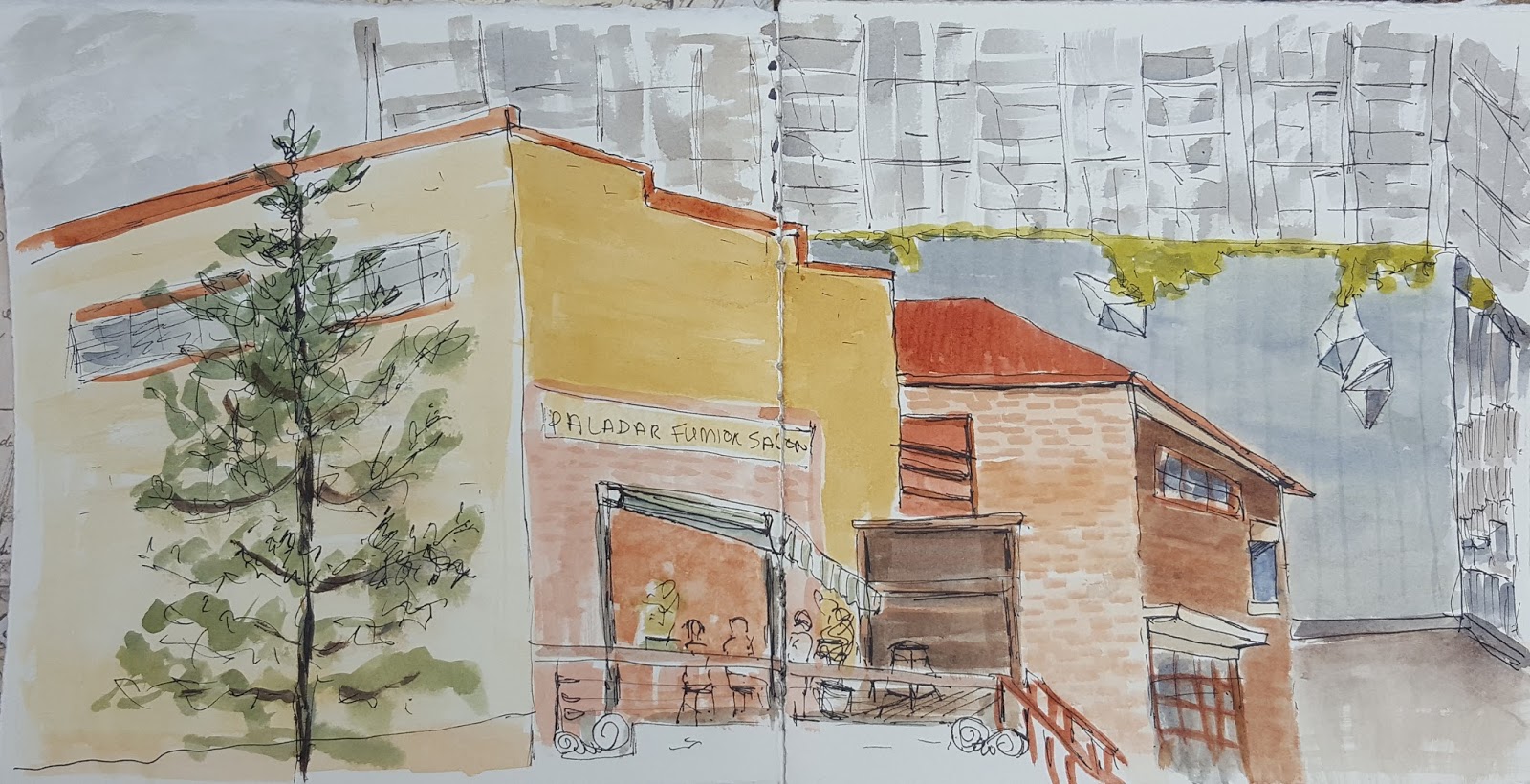
Monday, February 26, 2018

PALADAR FUMIOR SALON

Fun morning with the Brisbane City Sketchers in Fish lane South Brisbane this morning.  
A little history of Fish lane;
In December 1849, the Church of England acquired 1 acre, 3 roods, 8 perches of land on the
Southern side of the then ‘bridgeless’ Brisbane River for the purposes of building a church, school
and parsonage. The vacant land stretched along a block facing Melbourne Street in the scattered
settlement of South Brisbane, bordered by Grey Street on the south and Stanley Street on the north
(which at that time ran right through the suburb past Montague Road to the river).
Within a few years a small church, St Thomas’, was built on the site, set back some way from its
Melbourne Street frontage. This, only the second episcopal church in Brisbane, was a modest
building of ‘brick and rubble’, fenceless in a field from which cows and goats would occasionally
stray inside. During the week a school was run in the church and over the following decades
improvements to the building were gradually made and parishioners increased.Fish Lane, named after Mr George Fish was the track the parishioners use to get to the Church for services.
The church has long gone, and progress has taken over.
The PALADAR FUMIOR SALOON is one of the last remaining Art Deco Guest Houses.


Monday, February 19, 2018

Sketching in the Cultural Precinct

Wonderful morning with the Brisbane City Sketchers, eight of us came out to make art today.  We started at the Abutment on Victoria Bridge, and ended at the Collectors cafe  Qld Museum.


The Chai Cart on the Abutment.  fabulous coffee! The tracks you can see are remnants of the Tram Tracks of Bygone days..


Santos Place Brisbane sketched from the Collectors Cafe
Santos Place is a 6 Star Green Star office building in Brisbane, Queensland, Australia. Construction began in 2007 and was completed in 2009. It was formerly known as Northbridge before major Australian oil and gas exploration production company Santos bought naming rights for the building in January 2009. Santos occupies eight levels.


Thursday, February 15, 2018

Roma Street Parkland


Sketching with my friend on a very hot summers day in the Spectacle Garden at Roma Street parkland. The Spectacle Garden at Colin Campbell Place displays a vivid array of colour all year and includes a collection of flowers, herbs, water features and art works.Colin Campbell Place is in horticulturalist.

History of Roma Street Parkland
Pre-1825 – Local indigenous community used the area for meetings and ceremonies
1825 – Roma Street Parkland area was part of the original Brisbane settlement
1875 – Adjacent train station built as part of the main western railway to Brisbane linking Ipswich to Toowoomba
1911 to 1934 – Extensive redevelopment in the area, to support the increase in services
1920 – Massive excavation removed 554,300 cubic metres of earth, permanently altering the steep terrain creating the current day artificial escarpment and the boundary of the former Albert Park
World War II – Roma Street train station used for transporting war materials and military personnel up north
2000 – Construction of the current Roma Street Parkland
2001 – Updated Roma Street Parkland opened to the public
 
Both sketches done in my A4 Holcroft Sketchbook Pen and Watercolour.


 If you are looking for information about our Urban Sketching Group, click on the link below.


Wednesday, February 14, 2018

Fabulous morning with the Brisbane City Sketchers at Mater Hill.  We sketched the old Private Hospital.  Aubigny Place was the original Mater Private Hospital building, on what is now known as Mater Hill, opening in 1910  The building was designed by Hall and Dods who also designed the Lady Lamington Nurses Home at Royal Brisbane & Women's Hospital (RBWH)


Thursday, February 8, 2018

Brisbane City Sketchers at New farm Park

It is February and I have finally done my first sketch for 2018. (I have been under the weather a bit, but now I am back)

The Brisbane City Sketchers had their first Thursday Sketchout, and we went to New Farm Park. . New farm park was created in 1914, and currently covers 15.0076 hectares of land. Some 600 trees were planted including  jacaranda trees that line the circular  road around the park.

A4 Holcroft Sketchbook and pen 


Sunday, November 19, 2017

Brisbane City Sketchers in Manly

Sketching with the Brisbane City Sketchers on Manly Parade in Brisbane.  Manly is a very old settlement , once the playground of the very wealthy.

European settlement of the Manly area first took place around 1860. In 1882 land was sold by auction for the Manly Beach Estate, apparently named after Manly, New South Wales beach in Sydney. By the early 1900s the area had become a popular seaside location. Very large holiday homes were built, and people flocked for healthy holidays by the sea.

Today is is still an expensive place to live, but not as popular anymore.  When cars arrived on the scene, all the holiday makes fled to the northside of Brisbane to Sandgate.

Celtic Corner is an Irish eating house.  Gorgeous old building with no history, apparently.

Both sketches done in my A4 Holcroft sketchbook - Lamy pen - Watercolour


This is my friend John 


Related Posts Plugin for WordPress, Blogger...